


Expert urges a shift from turnover to operational margins
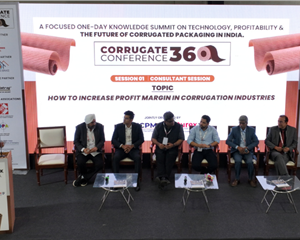
Business consultant Nirav Trivedi challenged corrugation manufacturers at CorruPack to prioritise standardised processes and waste elimination over customisation to reverse shrinking industrial profit margins.
23 Mar 2026 | By Jiya Somaiya

Nirav Trivedi, founder, Greendot Management Solutions
The Indian corrugation and machine manufacturing sectors are currently facing a systemic contraction in profitability due to high operational costs and reliance on customised production. Speaking at the Corrugate Conference 360 during CorruPack in Mumbai, Nirav Trivedi, founder of Greendot Management Solutions, stated that the transition from a cost-plus to a cost-minus model is now essential for survival.
In this framework, the market sets the selling price, and the manufacturer must generate profit solely by identifying and eliminating internal inefficiencies.
Standardisation gap
A primary barrier to scaling in the MSME sector is the lack of standardised product offerings. Trivedi noted that while multinational corporations thrive on rigid hierarchies and standardised outputs, small and medium enterprises often fall into the trap of a jumbled flow by accepting every customer request for modification.
This constant customisation leads to new designs, fragmented inventory, and unpredictable lead times. He asserted that no global firm has achieved significant scale through purely customised manufacturing, as it prevents the implementation of autonomous systems and forces business owners to remain involved in technical floor-level tasks rather than strategic growth.
Identifying hidden operational waste
Profitability in the corrugation industry is often suppressed by overproduction and excessive inventory. Many converters produce surplus material to mitigate long setup and changeover times, but this practice ties up liquid capital in raw materials and work-in-progress goods.
Trivedi identified this as a form of industrial diabetes, where businesses become dependent on bank credit facilities to cover working capital gaps. Furthermore, the cost of poor quality remains a hidden liability; a defect caught at the customer end is estimated to cost more than one detected during the initial production phase.
Asset utilisation and strategic growth
Efficiency metrics indicate a gap between domestic and global production standards. While international corrugation facilities often operate at over 85% overall equipment effectiveness, the average Indian plant utilises only 30% to 40% of its machine capacity.
Trivedi argued that instead of seeking capital expansion or new machinery, owners should focus on maximising the output of existing assets through three-shift operations. To achieve this, companies must transition to employing personnel trained to follow standardised scientific tools.
Actionable financial discipline
To restore cash flow, manufacturers must implement a rigorous inventory turnover ratio and evaluate their customer base for profitability.
Trivedi advised that healthy businesses should eventually learn to decline the bottom 5% of their least profitable customers to protect operational bandwidth. By shifting focus from subjective management to data-driven improvement, corrugators can reduce transportation wastes that currently characterise non-automated shop floors.
The objective remains to move the business toward an autonomous mode where decision-making is fast, standardised, and independent of the owner’s constant physical presence.







 See All