


Can corrugation industry beat the Chinese imports?
The humble brown box, the silent workhorse of the global supply chain, is at a breaking point in India, and battle lines are drawn between old-guard manufacturers, nimble innovators, and a flood of Chinese machinery.
23 Mar 2026 | By Jiya Somaiya

Strategic success hinges on automation, product excellence, and JIT efficiency
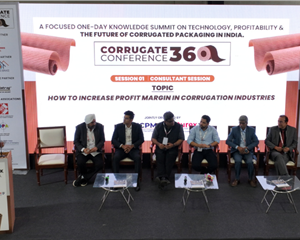
At a recent industry panel titled Technology Upgradation and Reducing Production Cost at CorruPack, the mood was one of both enormous opportunity—driven by the "China Plus One" manufacturing boom and a global push for paper-based sustainability—and existential crisis.
The core tension? Despite world-class technology being built at home, over 35 shipping containers of corrugated machinery arrive from China every single day, according to industry veteran Hitesh Nagpal of Natraj Industries. That’s tens of millions of dollars in foreign currency leaving the country, while Indian factories run at a fraction of their capacity. "We have better technology," Nagpal insisted, "but people are not trusting Indian manufacturers."
To survive this market pressure, Indian machine builders are moving beyond simple hardware to become solution architects. Raunak Singh Bhurjee of Sun-Up India detailed a new strategy of phased automation: developing flexible "mini-plants" that take up less than 100-feet of space, cost less, and can operate with a skeleton crew of seven or eight workers. This disruption allows smaller corrugators to scale their production from 100-tonnes to 300-tonnes a month without the massive layouts of the past.
This innovation is essential because the market is demanding a paradigm shift. Satyajit Dwivedi of Hindustan Unilever (HUL) confirmed that short-run, multi-pack, and promotional orders are now inevitable. The global industry, he noted, has already accepted that small, custom orders are the norm, not the exception.
The true cost of the brown box
But the biggest hurdle isn't capacity—it's cost.
Corrugators like Varthan Mathias of the Velvin Group argued that the current model, driven by cutthroat competition, does not account for the true complexity of modern packaging. He called for a radically transparent, industry-wide cost structure that factors in elements currently absorbed by the manufacturer: the cost of warehouse storage, damage during transit, surplus production, and even the cost of customer-mandated quality audits.
"We need to start with, 'What do you need to transport?' not, 'What is your box size?'" Mathias said, arguing that converters must transform into "solution providers" by building in-house R&D teams and offering supplementary products like edge protectors and custom fitments.
Deenu Shetty of Sunrise Packaging Industries said, "Corrugated boxes will remain the dominant packaging format." He added, "Right-sizing initiatives can reduce shipment volumes." Flexible packaging is emerging as the standout growth category, but corrugation is projected to outpace all other formats due to its efficiency and sustainability credentials."
Innovation is also being applied to sustainability: Natraj is using high-pressure piping to cut steam consumption in board plants by 50% (from 4000kg to 2000kg/hour), directly lowering board cost for end-users. Bhurjee shared an innovative case study about how the group created an alternative solution with its S Fold innovation.
The final word came from the academic and regulatory side. Dr Subodh Juikar of the Indian Institute of Packaging (IIP) affirmed the industry is on the cusp of a "golden days" moment. The institute is focusing its research on the key failure points—moisture content in coastal climates that causes board cracking, and poor adhesion due to rushed production.
To close the loop on the circular economy, an incentive structure was proposed: give eCommerce giants—with their robust delivery and reverse logistics networks—carbon footprint credits for actively collecting post-consumer corrugated scrap. The consensus is clear among the panellists: the opportunity is massive, but it will require a conscious shift away from a low-cost, low-trust model to one built on domestic innovation, transparent costing, and a shared commitment to building a durable, smarter brown box.
The panel concluded that the industry’s future success hinges on a commitment to the following key operational and strategic shifts. One thing that emerged was adopting appropriate technology focused on minimal wastage and more automation to reduce variable cost with minimal labour by shifting from offline to inline converting. Also, product excellence was stressed. And how manufacturing better strength board with lighter GSM grades and offering value-added boxes with multicolour printing, die-cuts, and wrap-arounds. And finally, simple, practical ideas to improve supply chain efficiency and how to work on a JIT (Just-in-Time) supply chain with better scheduling of raw material inventory and minimal finished goods inventory.
1. Automation is a necessity, not a luxury. To combat rising labour and electricity costs, automation is essential for all box sizes.
2. Embrace the era of short runs and bespoke production. Optimise factory setup and processes to prepare for inevitable shorter run lengths and higher SKU variety.
3. Implement transparent costing that accounts for every value-added. Develop a comprehensive cost structure that includes warehousing, audits, damage, and surplus production to ensure fair pricing and recovery.
4. Evolve from a box converter to a holistic packaging solution provider. Shift focus from simply selling a box to offering complete, technically-driven design and R&D solutions.
5. Build faith and buy from capable Indian machine manufacturers. Trust and support local manufacturers who offer competitive technology, better maintenance, and long-lasting machines.
6. Enable SME growth through phased, step-by-step automation. Design scalable, minimal-investment automation solutions that allow smaller manufacturers to grow and recover faster.
7. Reduce carbon footprint by championing energy efficiency. Innovate to decrease resource consumption, such as reducing steam usage in manufacturing, to lower board cost and enhance sustainability.
8. Prioritise the reverse collection of post-consumer scrap. Establish mechanisms, potentially with incentives for e-commerce, to capture and recycle corrugated scrap from end consumers.
9. Harmonise paper specifications to simplify complexity and drive savings. Collaborate to standardise paper grades and reduce the number of existing specifications.
10. Design for durability: account for moisture, temperature, and logistics. Focus R&D on ensuring structural integrity by accounting for climatic culprits like moisture content, especially in coastal areas.




 See All