


The secret to India's remarkably resilient print, packaging, and publishing fraternity — The Noel D'Cunha Sunday Column
India’s print leaders are redefining what makes a factory world-class. It is no longer about machines or scale, but about systems, discipline, and the ability to deliver consistent quality at speed. Noel D'cunha and Rahul Kumar report
04 Apr 2026 | By Noel D'Cunha

In a manufacturing sector defined by intense price compression and rapid technological obsolescence, India’s print, packaging, and publishing (P&P&P) leaders are looking beyond simple output metrics to define operational excellence. A survey of 140 P&P&P by PrintWeek reveals that the most admired factories are not merely high-volume units but integrated ecosystems that serve as benchmarks for systemisation, advanced automation, and an unshakeable corporate culture.
What is increasingly evident, however, is a deeper shift in how these leaders define excellence. Across responses, there is a clear move away from machine-led thinking to process-led manufacturing. The modern factory is no longer defined by the press it owns, but by the systems that run it, the data that informs it, and the discipline that sustains it.
The Survey also reflects how this shift is being interpreted across the industry. There is a growing emphasis on building systems early, embedding automation from the outset, and reducing dependency on individuals. For many, the modern factory is not something to evolve into, but something to design with intent from the beginning.
The list of admired facilities is led by packaging and printing conglomerates like ITC, alongside specialist players such as Srinivas Fine Arts and Pragati Offset and Multivista. Crucially, it also features a diverse array of non-P&P&P firms, ranging from the rigorous discipline of the automotive and pharmaceutical sectors to the massive scale of the oil and gas industry. This suggests that the modern CEO increasingly cross-pollinates best practices from across the manufacturing landscape.
Integrated benchmark
At the top of the list of admired facilities, mentioned by multiple leaders in the PrintWeek Survey, is ITC. The company is referenced for its comprehensive approach to manufacturing, including its core business and specific units such as the ITC Bhadrachalam factory and ITC's Packaging and Printing Business in Tiruvottiyur and Chennai.
Many participants said the Chennai unit has “set a high benchmark in terms of technology integration, sustainability practices, and quality standards,” encapsulating the triple mandate of modern manufacturing leadership: technology, ESG, and quality.
What emerges alongside this admiration is a growing aspiration to replicate not just scale, but integration. Leaders repeatedly emphasise end-to-end workflows, where pre-press, press, and post-press are synchronised through systems rather than manual intervention. The idea of “end-to-end workflow” and “process discipline” appears frequently, indicating that integration today is as much digital as it is physical.
There is also a clear focus on building end-to-end visibility through MIS, ERP, and data-driven planning tools. The emphasis is on creating a foundation where estimation, planning, and execution are tightly aligned through systems, rather than relying on individual intervention.
The recurring mention of ITC highlights a desire among P&P leaders to emulate the integration and scale demonstrated by large, diversified corporations.
Precision and niche
While scale is impressive, many industry leaders admire facilities that have achieved mastery in a niche or demonstrated operational precision within a defined scope.
Srinivas Fine Arts in Sivakasi receives multiple commendations for its dedication to infrastructure and niche creation. Innumerable persons describe it as having the “best infrastructure a printer can dream of,” underscoring the value placed on physical plant design and planning. Similarly, some said the company has “carved a niche for themselves”.
Another key segment is advanced packaging, where converters like TCPL Packaging, Parksons Packaging, and Vijayshri Packaging are celebrated for their modern, greenfield projects. Also, Parksons Packaging’s plant in Punjab is described as “simply spectacular”.
There is a nod to all the new plants like Yamir Packaging, Canpac Trends, and TCPL Packaging which are described as “fantastic with a vision of the next 20 to 25 years,” suggesting that a forward-looking design that anticipates technological and ESG needs is a critical element of admiration.
The operational rigour of Pragati Offset is also highly regarded. Many appreciate Pragati Offset’s “approach towards new technology,” confirming that the admired companies are those that consistently upgrade and innovate their core capabilities.
What distinguishes these specialist players is not just equipment, but control. There is a growing emphasis on colour science, substrate behaviour, and repeatability. Leaders speak of maintaining tight Delta-E tolerances, locking ink densities, and standardising processes upstream rather than correcting errors on press. This reflects a maturing industry where precision is engineered, not inspected.
This precision is increasingly approached with a blend of technology and judgement. Respondents highlight the importance of spectrophotometers, standard lighting conditions, and substrate-led profiling, while also acknowledging the continued role of human intervention in achieving consistent output. There is also a growing interest in material experimentation, from mono-material films to speciality papers, reflecting a shift towards value-added applications.
Learning outside print
Perhaps the most telling aspect of the leaders’ selection is the profound appreciation for operational discipline and automation perfected in adjacent, often high-stakes, industries. This cross-sector admiration indicates that P&P&P leaders view their core business challenges such as efficiency, cost control, and quality as solvable through lessons learned elsewhere.
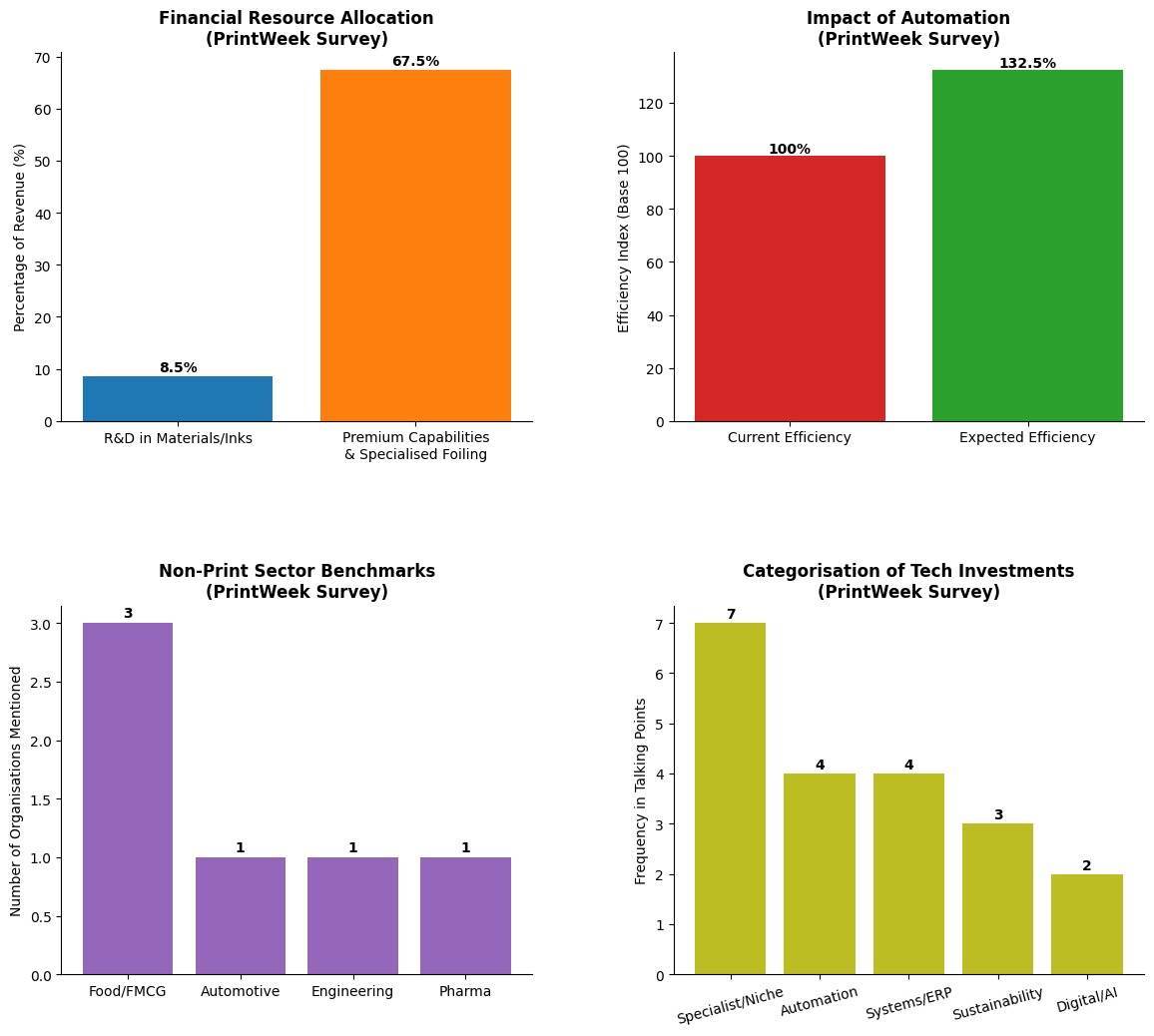
Instead of categorising them, many leaders point to factories outside the print sector as benchmarks for discipline and execution. Automotive plants such as Honda’s Greater Noida facility are cited for their culture of efficiency and respect, while engineering-led units like Amaron are recognised for their system-oriented approach.
Pharmaceutical facilities, particularly Cipla’s plants, are admired for their automation, compliance, and rigorous quality systems. In some cases, print factories themselves are benchmarked against pharma shopfloors, reflecting the elevated expectations around cleanliness and process control.
Even food and FMCG operations, from Amul’s dairy plants to Milky Mist and Chitale Bandhu, are referenced for their ability to combine scale with automation, often in environments traditionally seen as manual.
These non-P&P&P examples serve as aspirational models for efficiency and systemisation.
A key takeaway shared by one participant from Kolkata, from a visit to a factory in China, was the extent of automation. Only ten people were on the floor managing the complete operation.
What is new, however, is how Indian print leaders are internalising these lessons. Automation is no longer viewed as a cost-saving measure alone, but as a strategic necessity to reduce variability, improve consistency, and enable scale without proportional increases in manpower. Investments in AI-driven systems, predictive maintenance, and real-time data capture reflect a mindset where automation is embedded into the DNA of the factory rather than added incrementally.
Beyond the factory
The criteria for admiration are shifting. While massive scale remains a marvel, the underlying themes are increasingly centred on sustainability, systems thinking, and human capital management.
Many participants were impressed by Lovely Offset's focus on recycling and environment friendliness and Multivista's adherence to exacting EcoVadis standards, while others cited Avery Dennison’s commitment to “innovation, quality, and sustainability”.
Yet sustainability itself is being redefined. Rather than being limited to material substitution, it is increasingly understood as efficiency. This includes reducing waste, minimising rework, optimising grammage, and designing processes that do more with less.
This thinking is reflected consistently across responses, where sustainability is framed as responsible decision-making at every stage of production, balancing environmental impact with commercial viability. The emphasis is on building systems that reduce waste at source rather than relying solely on downstream solutions.
Equally, there is a noticeable cultural shift. Leaders are placing greater emphasis on accountability, transparency, and respect for process. Deal-breakers cited include compromising on quality, ignoring systems, and failing to honour commitments. This reflects an industry that is becoming less tolerant of operational ambiguity and more focused on disciplined execution.
In parallel, there is a growing confidence in India’s global positioning. Several leaders reference the ability to match international quality standards while maintaining competitive pricing, alongside ambitions to build export-ready, globally benchmarked facilities.
Taken together, the perspectives suggest a convergence in thinking. Across the board, there is alignment on one fundamental shift. Competitive advantage in print manufacturing is moving away from machinery and towards systems, discipline, and the ability to execute consistently.
In conclusion, the factories admired in PrintWeek's Survey are not just places of production. They are strategic assets designed for long-term resilience. The highest praise is reserved for facilities that have successfully layered cutting-edge automation over robust, disciplined internal systems, while simultaneously committing to high benchmarks for quality and sustainability. For India’s print, packaging, and publishing leaders, the factory floor is no longer just about meeting deadlines. It is the ultimate expression of corporate strategy and a testament to enduring operational integrity.






 See All