


The Noel D'Cunha Sunday Column | Looking back at 2025: What shaped performance (Part-II)
As we step into 2026, PrintWeek examines how industry leaders responded to shifting demand, rising operational complexity, and margin pressure in the year gone by. In this Sunday Column, eight CEOs reflect on value creation, technology choices, and the decisions that defined performance across the year. Read on….
11 Jan 2026 | By Noel D'Cunha

How Esscee Printpack built growth around speed, complexity, and control

KR Chandrashekar, partner at Esscee Printpack, outlines how short-run efficiency, automation, and sustainability-led investments positioned the business for a market defined by SKU fragmentation and operational complexity
For much of India’s packaging sector, 2025 reinforces a structural change that has been taking shape for several years. Brand owners no longer reward capacity alone. Instead, they place greater emphasis on speed, flexibility, and the ability to deliver differentiated packaging under tighter timelines and sustainability requirements. At Esscee Printpack, this shift defines the year.
KR Chandrashekar, partner at Esscee Printpack, points to customer demand rather than volume growth as the main driver of momentum. While output increases across FMCG, food, and personal care, the more meaningful uplift comes from a shift in value mix. “Brands are prioritising differentiation and sustainability,” he says, “which allows us to contribute higher-value solutions rather than simply higher output.” Shorter lead times, customisation, and functional enhancements increasingly shape job profiles.
The contrast with three years ago is clear. Sustainable and mono-material packaging, once limited in scope, now forms part of mainstream demand. Regulatory signals and brand commitments accelerate adoption, turning earlier trials into repeat business. Alongside this, Esscee’s folding carton and finishing segment gains traction, driven by demand for structural variation and surface treatment as brands compete for attention at retail.
Not all segments move in the same direction. Traditional commercial print contributes less to the overall mix as digital alternatives expand and corporate spending remains cautious. Chandrashekar notes that the segment continues to play a role, but its relative importance has declined.
From a long-term perspective, the most telling indicator of progress is not topline growth. Chandrashekar instead points to the growing share of recurring business tied to multi-year contracts. “We are more embedded in our clients’ supply chains,” he explains. This reflects investments in process control, quality systems, and operational reliability, signalling integration rather than transactional engagement.
Cost pressures during the year reinforce the value of this approach. Input prices for paperboard, films, and chemicals fluctuate, leading to periodic price adjustments. These account for only part of revenue growth. Nearly two-thirds, Chandrashekar says, is driven by market demand, new customers, and higher-value applications. Price revisions help protect margins but do not define performance.
Operational investments focus on managing complexity. As automation and AI reshape manufacturing workflows, Esscee directs capital towards prepress automation, inline inspection, and integrated workflow platforms that connect job onboarding, scheduling, proofing, and MIS. The objective is predictability rather than speed alone. “Reducing touchpoints and turnaround time was critical,” Chandrashekar says, enabling the business to handle a wider range of jobs without compromising consistency. These systems also shift teams away from repetitive intervention towards decision-led roles.
The most significant strategic investment responds to a broader market shift. Esscee expands capacity for short-run, fast-changeover packaging through hybrid printing and automated finishing lines. The rationale is straightforward. SKU fragmentation, regional variation, and shorter design cycles are no longer episodic. “This change is structural,” Chandrashekar explains, adding that efficient small-batch production is becoming a baseline capability.
Profitability patterns reflect this shift. While large clients continue to provide volume stability, higher margins increasingly come from specialised smaller customers. These projects typically require distinctive structures, recyclable substrates, or controlled finishing. “They allow us to apply our technical capability more effectively,” Chandrashekar says, translating operational strength into margin performance.
Sustainability initiatives contribute financially through multiple channels rather than premium pricing alone. The market remains price-sensitive. Gains instead come from higher adoption of recyclable formats, lower waste, energy-efficient equipment, and improved material utilisation through design changes. Sustainability, in practice, functions as both a customer requirement and an internal efficiency driver.
Every diversified operation also relies on stability. For Esscee, FMCG and personal care packaging provides that base. Demand remains consistent, and SKU diversity supports steady utilisation of converting and finishing capacity. Chandrashekar describes the segment as a steady contributor, supporting working-capital discipline and planning through the year.
Leadership priorities in 2025 reflect the need to manage overlapping cycles of technology adoption and customer expectation. Chandrashekar emphasises staying close to operations and clients, grounding decisions in execution realities. Investment in team development enables delegation, while continuous learning, particularly in automation and sustainability, helps maintain clarity.
Some assumptions also shift during the year. Chandrashekar acknowledges initial scepticism around AI-assisted prepress and automated colour calibration. “Once we saw the consistency across shifts, it was clear that AI supports capability rather than replacing it,” he says. A finishing module initially viewed as discretionary proves commercially useful by attracting specialised work. If one industry practice could be removed, he adds, it would be over-promising delivery timelines to secure orders, which he believes undermines planning and credibility.
One moment during the year reflects the company’s direction. A machine operator independently improves waste levels by adjusting a setup without instruction. For Chandrashekar, this ownership reflects the continuing relevance of print as a craft built on judgement and accountability.
Looking back, the year reinforces a clear lesson. “Agility matters more than scale,” Chandrashekar says. In a market shaped by faster quoting, prototyping, and SKU switching, advantage increasingly lies with those able to adapt quickly rather than those operating the largest assets.
Kwality Labels rides premium demand with LED-UV and workflow speed

Krish Chhatwal, director at Kwality Labels, reflects on a year where premiumisation, automation, and sustainability-led investments reshaped margins, strengthened cash flows, and repositioned the business
For label converters, 2025 increasingly separates scale from value. Volumes alone no longer guarantee returns, particularly as brand owners demand differentiation, sustainability credentials, and shorter lead times. At Kwality Labels, the year marks a shift towards premiumisation as a growth and margin strategy.
Reviewing performance from January to December, Krish Chhatwal attributes growth primarily to a change in value mix and evolving customer demand. While volumes remain stable, revenue growth is driven by higher-end applications. “We saw a shift towards premium label solutions, particularly in the spirits and food segments,” he says. Demand for specialty finishes and higher-grade substrates lifts average order values without a parallel push for volume expansion.
The shift is clearer when viewed against the company’s position three years earlier. What was once a small premium labels segment now contributes a larger share of revenue. Chhatwal notes that early investments in sustainable and premium packaging placed Kwality Labels in a position to respond. “The shift was faster than we expected,” he explains, “but investing early worked in our favour.” Premium labels move from a trial phase to a structural part of the business.
From a long-term perspective, progress is reflected less in topline growth and more in operational capability. Investments in automation and digitalisation streamline workflows, reduce waste, and improve consistency. Chhatwal views these changes as foundational. “We’ve streamlined our workflow and improved efficiency,” he says, framing automation as an enabler rather than a short-term cost lever.
Cost volatility during the year reinforces the importance of this discipline. Input prices fluctuate, but Kwality Labels absorbs a significant share of the increase. Around 70% of revenue growth, Chhatwal says, comes from underlying demand, with the balance linked to price adjustments. “We absorbed as much of the cost increase as possible,” he notes, prioritising continuity of customer relationships.
Technology investment supports this approach. The company focuses on digital pre-press and workflow automation to shorten lead times and strengthen quality control. These systems allow Kwality Labels to manage more complex jobs while maintaining predictability. “It has improved how we handle demanding work,” Chhatwal says, particularly as job specifications become tighter.
The most significant strategic investment during the year is linked to sustainability rather than capacity expansion. Kwality Labels installs a UV LED curing system in response to customer requirements for lower environmental impact. The technology reduces energy consumption and waste. “This investment reflects what customers are asking for,” Chhatwal says, positioning sustainability as a commercial requirement rather than a branding exercise.
Profitability patterns reflect this evolution. Higher margins increasingly come from specialised smaller customers rather than large anchor accounts. These clients value customised solutions and technical capability. “They are willing to pay for specialised work,” Chhatwal notes, allowing the business to convert expertise into margin improvement.
Sustainability initiatives contribute financially through both pricing and efficiency. Adoption of eco-friendly labels supports price realisation, while waste reduction and energy efficiency lower operating costs. Together, these effects strengthen the case for sustainability-led investments beyond compliance.
Within this mix, premium labelling provides stability. Long-term relationships in this segment deliver predictable cash flows through the year. Chhatwal describes demand as consistent, supported by repeat business rather than project-driven spikes.
Leadership priorities during the year focus on balance and delegation. Chhatwal emphasises team empowerment alongside personal routines. “Delegating helped me focus on strategic decisions,” he explains. Exercise, meditation, and time with family support clarity as operational demands increase.
Some views also evolve during the year. Chhatwal acknowledges earlier scepticism around digital printing, which now forms a larger part of the business. Investments such as UV LED curing no longer appear risky in hindsight, given their operational benefits. If one industry practice could be removed, he says it would be wasteful packaging, arguing that sustainability should become a baseline expectation.
One moment during the year captures the motivation behind these changes. Seeing a client launch a product carrying a Kwality label reinforces the tangible impact of the work. For Chhatwal, it underlines why adaptation and reinvestment remain necessary.
Avantika Printers bets on rigid boxes and hybrid craft as margins tighten
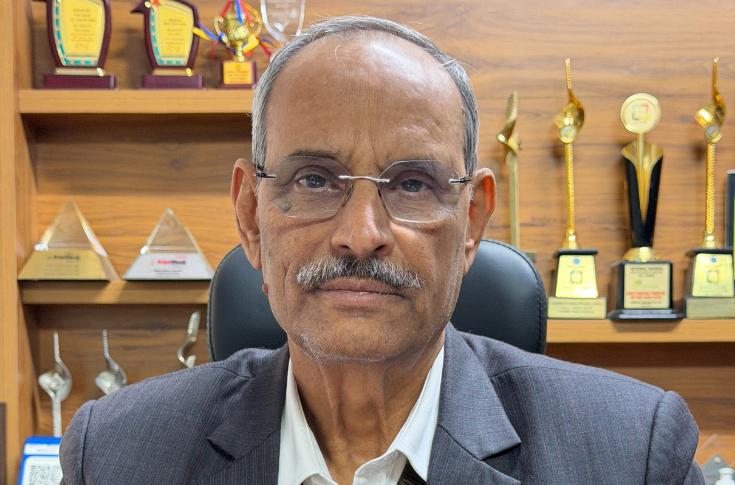
MN Pandey, director at Avantika Printers, reflects on a year shaped by a stronger value mix, fabrication-led packaging work, and a gradual shift from expansion towards consolidation and leadership transition
For much of India’s print industry, 2025 sharpens a long-standing reality. Growth is no longer secured by printing alone. It increasingly depends on how printed products are constructed, finished, and differentiated. At Avantika Printers, this dynamic defines the year.
Reviewing performance from January to December, MN Pandey describes growth as modest and deliberate, driven mainly by a shift in value mix. Volumes remain under pressure as margins tighten across the sector. What sustains the business, he explains, is not scale but the ability to add value through complexity. “The focus has clearly shifted to value,” Pandey says, noting that customer additions help offset broader pressure on profitability.
The most visible change compared to three years ago lies in the nature of demand. Packaging continues to drive activity across the industry, and within that, rigid boxes gain share. Pandey points to this segment as aligned with Avantika’s capabilities. As brands place greater emphasis on presentation and durability, rigid boxes emerge as a format where fabrication, structure, and finish carry as much weight as print quality.
From a long-term perspective, Pandey sees the clearest indicator of strength in the company’s approach to product development. Avantika invests in work that combines multiple print processes with fabrication. “Products using a mix of digital, screen, and offset, supported by fabrication, have become central to our offering,” he explains. This hybrid approach allows the company to address complex briefs rather than compete in commoditised segments.
Cost pressures during the year remain pronounced. Input volatility and competitive pricing reduce overall profitability, leaving limited scope for margin-led growth. Pandey is direct about the impact. “There has been a reduction in profitability,” he states, adding that incremental growth is managed largely through new customer onboarding rather than price increases. In this environment, caution replaces expansion.
Operational investment reflects this approach. Automation during the year is focused on pre-press, where efficiency gains are more immediate. Larger capital commitments are assessed carefully. The most significant strategic investment, Pandey notes, remains under evaluation. “We are still weighing the options,” he says, signalling restraint in a year where aggressive expansion carries risk.
Profitability patterns reinforce this shift. Higher margins increasingly come from specialised smaller clients rather than large anchor accounts. These customers seek distinctive packaging solutions and are less driven by price competition. “Smaller specialised clients value what we offer,” Pandey explains, supporting the move away from volume dependence.
Sustainability initiatives progress under constraint rather than incentive. Competitive pressure limits the ability to charge a premium for responsible manufacturing. Instead, operational efficiencies become the primary lever. “Operational savings are the saviour,” Pandey says, positioning sustainability as a requirement for cost control rather than differentiation.
Within this context, finishing and fabrication provide stability. These capabilities generate consistent cash flow and help anchor the business when print volumes fluctuate. For Avantika, finishing is no longer an adjunct to printing but a central source of value creation.
Leadership priorities during the year reflect a broader transition. Pandey remains engaged by change, drawing insight from developments beyond the domestic market. “I thrive when challenges are thrown at me,” he says, adding that exposure to international trends continues to inform decisions.
Pandey maintains an open stance towards technology, noting that while he does not dismiss new approaches, adoption must be timed carefully. Not every investment delivers the intended return. A box packaging investment, he admits, does not prove viable, underscoring the risks inherent in experimentation.
If one industry practice could be removed, Pandey is clear. “The price war must end,” he says, arguing that sustained undercutting erodes value and weakens incentives to invest.
One reflection towards the end of the year signals a personal shift. “It is time to hand over the reins of the company to my children,” Pandey says. His focus, he adds, is beginning to extend beyond day-to-day operations towards broader industry engagement.
Why print on demand has become Arihant’s growth infrastructure

Parvesh Jain, director at Arihant Publication, reflects on a year where print on demand, automation, and targeted investments in web offset and bindery reshaped the economics of book publishing and production
In Indian book manufacturing, 2025 underlines a structural shift. Growth no longer comes from printing larger volumes of the same titles. It comes from producing the right books, in the right quantities, at the right time. At Arihant Publication, this recalibration defines the year.
Performance during the year is shaped primarily by a change in value mix and evolving customer expectations. Parvesh Jain points to growing demand for books that deliver clarity in content, format, and availability rather than scale alone. “The shift is towards value addition,” he says, noting that publishers and distributors increasingly expect faster turnaround, flexibility, and consistency over bulk output.
This shift is most visible in print on demand. Three years ago, print-on-demand (POD) played a supporting role in the portfolio. By 2025, it become central. Demand for shorter runs, quicker replenishment, and lower inventory exposure accelerates adoption. Jain described POD not as a niche, but as a response to how the book market now operates. Importantly, no part of the portfolio sees a meaningful decline, reinforcing the view that POD complements rather than replaces conventional production.
From a long-term perspective, Jain sees the clearest indicator of strength in the rising share of value-added books. These are titles where production complexity, binding quality, and finishing standards matter as much as print. “Value-added books have become a core part of our business,” he explains, positioning them as protection against commoditisation in publishing.
Revenue growth during the year reflects this structure. Around 80% is driven by underlying demand, with the remainder linked to secondary factors rather than pricing actions. Jain notes that this distinction is important. Growth supported by demand signals durability, while price-led gains tend to be fragile in a competitive publishing environment.
Operationally, automation underpins the transformation. Arihant continues to invest in making workflows faster, leaner, and more predictable. Automation enables the business to manage greater complexity without additional friction, particularly as job profiles expand across POD and conventional runs. Jain keeps the rationale straightforward. “Automation is critical,” he says, framing it as a requirement rather than an option.
The year’s major capital investments reinforce this direction. Arihant installed two Heidelberg Harris X web printing presses, expanding high-speed production capacity, and strengthens bindery capability with the Kolbus KM 472. These moves were aligned with expectations of sustained demand for efficiently produced, value-added books. The combination of web offset and advanced binding allowed the company to serve both scale and specification within a single production ecosystem.
Profitability patterns follow a similar logic. Higher margins increasingly come from specialised smaller customers rather than large anchor accounts. These clients value responsiveness, flexibility, and quality, and are prepared to pay for it. Jain views this as a sign that margins are being earned through relevance rather than dependence on volume concentration.
Sustainability initiatives progress without fanfare. Financial benefits come primarily from efficiency rather than premium pricing. Reduced waste, optimised run lengths, and better utilisation across POD and conventional lines help absorb cost pressures while maintaining customer relationships.
Within this framework, POD also functions as a stabilising element. Its ability to generate predictable cash flow without inventory build-up makes it particularly valuable in a market where demand visibility is uneven. Jain describes POD as both a growth driver and a risk-management mechanism.
Leadership priorities during the year remain pragmatic. Jain does not point to routines or resets, but to focus. “I just focus on the goals,” he says, suggesting that decisiveness matters more than deliberation in a production-led environment.
Looking back, the year brings few regrets. No major equipment investment appears mistimed in hindsight. If one industry practice could be eliminated, Jain is clear. “Piracy of books must end,” he says, pointing to its impact on publishers, printers, and authors.
What continues to motivate him remains unchanged. Jain speaks of a long-standing engagement with books, now combined with interest in automated and online machinery. For him, the future of print publishing lies in this intersection. Reflecting on the year, he draws a simple conclusion. “2025 confirmed the growth of the press,” he says, framing expansion not as nostalgia, but as adaptation.
How Holosafe Security Labels turned labels into instruments of trust

Preeti Mishra, director and head of business development at Holosafe Security Labels, outlines how authentication, traceability, and data-led security solutions reshaped customer relationships and redefined the role of labels
Across the packaging and labels industry, 2025 marks a clear shift in how labels are valued. They are no longer viewed only as identifiers or branding elements. Increasingly, they function as tools for trust, compliance, and consumer assurance. At Holosafe Security Labels, this change shapes the year.
Growth is driven less by volume and more by a move towards security-led solutions. Preeti Mishra points to rising demand for tamper-evident labels, holographic security features, and the company’s TraceGuard+ track-and-trace platform. “Brands are no longer purchasing labels as a commodity,” she explains. “They are investing in authentication, compliance, and consumer trust.” This change in buyer behaviour lifts the value mix and deepens engagement within existing accounts.
Design and protection increasingly converge. Integrated holographic foils embedded into label structures gain traction by serving both visual and security functions. Mishra describes these as solutions that “bridge aesthetics and protection”. Interest in in-mould labelling also grows, particularly among brands seeking durability and consistency. Together, these developments support higher-value demand and repeat engagement.
The contrast with three years earlier is most visible in regulated sectors. Pharma serialisation and traceability accelerate during the year, driven by regulatory readiness and heightened awareness of counterfeit risk. Alongside this, premium FMCG labels perform better than expected. Brands adopt textures, embellishments, and security features even for mass-market SKUs, signalling a broader reassessment of protection standards.
Not all segments follow this path. Commodity labels contribute less as price-led procurement intensifies. Holosafe responds by narrowing its focus away from low-margin work. Mishra frames this as a deliberate allocation of resources towards segments where security and data capabilities matter.
From a long-term perspective, the strongest indicator of progress lies in customer behaviour. Holosafe sees higher retention among enterprise clients and increasing wallet share within existing relationships. “We’ve moved from being a supplier to becoming a security partner,” Mishra says. This shift is supported by investment in machinery, digital systems, and secure production workflows that improve control and visibility.
Revenue growth reflects this structure. Around 70% is driven by demand for higher-security and traceability solutions, with the remainder linked to price adjustments for materials and energy. Mishra is clear where momentum lies. “The growth is coming from customers choosing more advanced solutions,” she explains, rather than from higher volumes of standard labels.
Automation plays a central role in managing this complexity. Holosafe invests in inspection, workflow planning, and quality control systems to reduce manual intervention and turnaround times. These systems integrate with the TraceGuard+ platform, enabling accurate serialisation, data capture, and tracking. “Real-time data visibility was critical,” Mishra says, noting improvements in predictability and error reduction. The shift, she adds, is as much about accountability as speed.
The most significant strategic investment during the year is the scaling up of track-and-trace and authentication infrastructure. This includes serialisation capability, QR-based verification, RFID integration, and digital dashboards. Mishra explains that customer expectations have moved quickly. “The value now lies in linking the physical label to the digital ecosystem,” she says, changing the nature of client conversations and opening new revenue streams.
Profitability patterns underline the transition. While large clients provide stable volumes, higher margins come from specialised customers seeking customised security features. These include advanced holography, textured finishes, and smart labels combining QR and RFID verification. “They value speed, customisation, and confidentiality,” Mishra notes, supporting margin discipline.
Sustainability initiatives progress on practical terms. Liner recycling, waste reduction, and energy optimisation deliver financial benefits primarily through operational savings rather than premium pricing. Adoption remains compliance-driven, but internally the gains are visible through lower wastage and improved resource use.
Within this portfolio, FMCG and personal care labels provide stability. Mid-volume SKUs generate predictable demand and repeat orders, supporting steady utilisation and cash flow through the year.
Leadership priorities reflect the need to balance execution with structure. Mishra draws on her banking background to separate operational intensity from strategic thinking. Team engagement, delegation, and recognition of progress help sustain momentum. “What kept me energised was building something new,” she says, referring to the intersection of manufacturing, technology, and brand protection.
Some views also evolve during the year. Mishra becomes more receptive to AI-led inspection and predictive workflow tools, which move from optional to necessary in high-security applications. Not every investment delivers immediate returns. A specialised offline finishing system takes longer than expected to reach utilisation, testing patience before contributing meaningfully.
If one industry practice could be removed, Mishra is clear. “Race-to-the-bottom pricing,” she says, arguing that it undermines quality and safety. One client moment captures the appeal of the work. A multi-layer label combining QR, RFID, and holographic security is described as “science plus art”, a phrase Mishra sees as accurately reflecting the sector.
Reflecting on the year, she draws a direct conclusion. “Technology will shape the future of packaging more than capacity,” Mishra says. For Holosafe, aligning early with that reality becomes the basis of a more defensible position in a market where trust increasingly carries value.
How Khosla Printers read the shift to premium before it settled

Sanjay Khosla, managing director at Khosla Printers, reflects on a year in which premiumisation, customisation, and operational discipline helped the business move steadily up the value chain
In printing and packaging, growth rarely comes from repeating existing models. It comes from recognising shifts in customer expectations early and adjusting before those shifts become widely visible. At Khosla Printers, this approach defines the year.
Performance is shaped less by output growth and more by how production aligns with changing demand. Sanjay Khosla describes the year as one focused on execution quality rather than scale. “We focused on producing smarter, not just producing more,” he says. Customers increasingly seek packaging that supports brand positioning, improves shelf presence, and aligns with sustainability goals. By responding with customised solutions, premium finishes, and responsible materials, Khosla Printers increases both order flow and value per job.
The contrast with three years earlier is visible in the portfolio mix. Premium and customised packaging, once a small part of the business, becomes a faster-growing contributor. “What stood out was how quickly clients moved towards higher-value solutions,” Khosla explains. At the same time, standard high-volume work accounts for a smaller share of overall contribution. This reflects a deliberate shift towards differentiated assignments rather than a contraction in demand.
From a long-term perspective, Khosla sees strength in fundamentals that are not always immediately visible. Talent depth, operational resilience, and customer trust matter more than any single metric. “Our foundation is stronger and our direction clearer,” he says, pointing to an organisation better equipped to adapt as conditions change.
Cost volatility during the year does not materially alter this picture. Most revenue growth is driven by underlying demand rather than pricing actions. Price adjustments are applied selectively to manage input cost movement, but they play a secondary role. Customer retention and repeat engagement remain the primary drivers, reinforcing confidence in the quality of growth.
Operational investment remains practical in scope. Rather than pursuing automation for its own sake, Khosla Printers focuses on colour consistency, faster changeovers, and preventive maintenance. These measures reduce waste and stabilise output. “Consistency and smooth production matter more than headline automation,” Khosla notes, framing efficiency as reliability rather than speed alone.
The most significant strategic investment during the year follows this logic. Printing and packaging lines are upgraded to support shorter runs, quicker changeovers, and tighter quality control. The objective is to respond to higher customisation without adding strain to operations, as customers increasingly expect faster delivery without compromise on finish.
Profitability patterns align with this structure. Large anchor clients continue to provide steady revenue, while higher margins come from specialised smaller customers with premium requirements. These assignments reward service quality, attention to detail, and technical execution. “Premium projects deliver better profitability because they value service, not just price,” Khosla explains.
Sustainability initiatives progress alongside core operations. Financial returns come from a combination of modest price realisation, broader adoption, and operational efficiencies. Reduced waste, disciplined processes, and improved energy management support margins without reliance on green premiums. Sustainability functions as an operating discipline rather than a promotional lever.
Within the portfolio, mid-volume repeat clients provide stability. These customers may not generate attention or the highest margins, but their consistency ensures predictable cash flow. Khosla describes them as central to planning and measured investment decisions.
Leadership priorities during the year centre on balance and structure. Khosla focuses on clear prioritisation, delegation, and reflection. Staying connected to teams and recognising progress helps maintain momentum without escalation. Pressure, he suggests, is managed through clarity rather than intensity.
Looking back, Khosla reflects on broader industry behaviour. If one practice could be eliminated, he points to forms of competition that prioritise short-term wins over long-term value. On leadership, he offers a pragmatic note. “Sometimes winging it works better than overplanning,” he says, suggesting that judgement remains as important as process.
Pulling capability inward to strengthen resilience at S&S Packaging
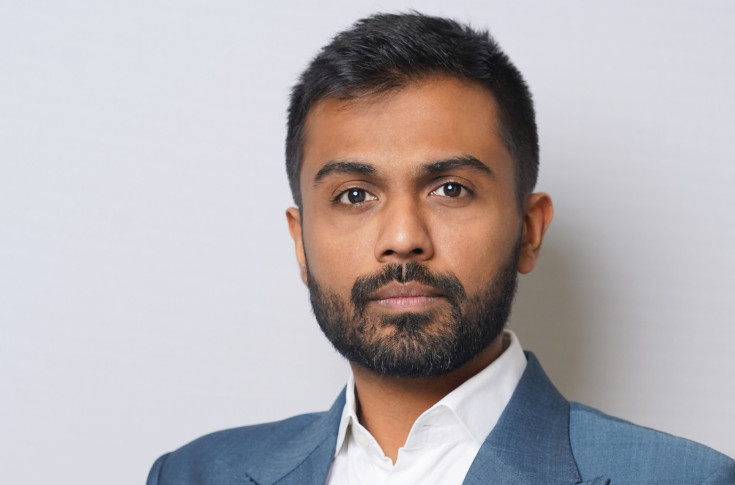
Siddhant Savla, partner, COO and vice-president of business development at S&S Packaging, explains how deliberate diversification, in-housing critical processes, and precision-led investments reshaped the company’s value mix and operating resilience
For businesses rooted in a dominant category, growth brings a structural challenge. Prolonged reliance on a core segment increases exposure, while rapid diversification can dilute stability. At S&S Packaging, the past year is defined by how that balance is managed.
Historically anchored in the cigarette industry, the company enters the year with a clear intent to broaden both its customer base and operational capability. Growth is driven less by volume expansion alone and more by a deliberate shift in value mix. Siddhant Savla describes this as strengthening existing strengths while reducing dependence on any single segment. Investment follows this logic. New equipment includes a high-precision slitting machine with tight tolerances, a two-colour high-speed registered foiling line for reel-to-reel applications on films and tipping paper, and a pasting machine that brings mono-carton and corrugated work in-house.
These additions allow S&S Packaging to consolidate processes, shorten turnaround times, and offer more integrated delivery. Customer response reflects this shift, with the client base expanding across industries and regions.
Viewed over a three-year horizon, the change is structural. The cigarette segment continues to deepen through specialised applications, but growth increasingly comes from adjacent verticals. Pharma mono-cartons and stationery show steady expansion. Food, FMCG, and soft-pack labels perform ahead of internal expectations, validating the diversification strategy and contributing meaningfully to revenue.
From a long-term perspective, Savla points less to financial ratios and more to operating structure. The company remains debt-free and profitable, but the more significant shift lies in execution. At the start of the year, several critical processes such as pasting and lamination are outsourced, creating potential delays and limiting quality control. Bringing these stages in-house becomes a priority.
“The moment we internalised these processes, control improved,” Savla explains. Lead times shorten, workflows stabilise, and delivery becomes more predictable. Combined with reduced reliance on a single sector and the addition of new capabilities, this operational control becomes a key indicator of resilience.
Revenue growth during the year reflects organic expansion. Around 80% is driven by underlying demand through new clients, higher throughput, and diversification. Price adjustments account for the balance and are applied to manage input cost movement rather than to drive growth. Savla notes that this split reflects the underlying strength of the business.
Operationally, visibility replaces intuition. S&S Packaging implements a customised ERP aligned to packaging workflows, bringing costing, production tracking, and planning onto a single platform. “Visibility was the most important upgrade,” Savla says. Real-time data and predictive costing improve response times and reduce manual inefficiencies across the plant.
Strategic investments during the year come as a cluster rather than a single initiative. Alongside foiling and slitting lines, the company adds a Luster inspection system and high-efficiency pasting equipment. Intradeck units integrated into the offset press expand finishing capability, enabling UV drip-off, met-PET, multi-colour foiling, and controlled converting. Together, these investments increase the range of finishes that can be delivered in-house.
“These were enablers,” Savla says. Customers increasingly expect shorter lead times, premium finishes, and single-vendor accountability. By consolidating multiple stages of production internally, S&S Packaging improves reliability for both domestic and export clients.
Profitability patterns reflect this positioning. Higher margins are generated from large-volume anchor clients that combine scale with value-added requirements. Volume consistency supports investment, while finishing complexity protects margins without pushing the business into narrow niches.
Sustainability initiatives progress alongside operational priorities. Solar capacity expands to cover around 5% of connected load, contributing to responsible manufacturing. Financial impact comes primarily from demand strength and value-added processes rather than sustainability premiums. Techniques such as drip-off, met-PET, and controlled foiling continue to support margins.
Within the portfolio, cigarette packaging and stationery provide stability. Their predictability and steady order flow support cash generation, allowing continued investment and diversification without balance-sheet strain.
Leadership priorities during the year emphasise proximity and accountability. Savla stays close to production through regular walkthroughs and technical discussions. “Staying connected to the shop floor improves decision-making,” he explains. Building ownership within teams becomes equally important, with employees encouraged to identify inefficiencies and propose improvements.
Personal discipline also plays a role. Structured routines and deliberate rest help maintain clarity during high-pressure phases. Savla describes leadership effectiveness as a balance between engagement, delegation, and managing mental bandwidth.
Some views evolve during the year. Savla becomes more receptive to AI tools after initial caution, noting their accuracy and adaptability. Not every investment feels equally critical in hindsight. His laptop, he remarks, is used less than his phone. If one industry habit could be eliminated, he points to continued overuse of plastic where fibre-based alternatives are viable.
What remains motivating is the people. Interactions with technically engaged professionals reinforce Savla’s view that packaging advances through shared knowledge. Reflecting on the year, he draws a clear conclusion. “A company grows fastest when people feel trusted to lead at every level,” he says.
At S Kumar Multiproducts, diversification follows discipline

Tania Hansoti, director at S Kumar Multiproducts, reflects on a year where volume-led growth in labels, the launch of a monocarton line, and steady investment in people reshaped the company’s trajectory
In printing and packaging, expansion often runs ahead of readiness. New lines are added, complexity increases, and organisations struggle to absorb change. At S Kumar Multiproducts, the past year unfolds differently. Growth is paced and layered, built on a core business that continues to perform.
The primary driver remains labels. Higher volumes in the core labels business support overall performance, accompanied by a gradual shift in value mix. Alongside this, a newly launched monocarton line contributes incremental growth in the second half of the year, adding capability without destabilising the base. Hansoti describes the period as one where scale and capability progress together rather than in tension.
The contrast with three years earlier is most visible within the labels portfolio. Premium and specialty labels grow faster than anticipated. Embossed and value-added formats are no longer confined to premium categories. Increasingly, they appear across mass-market products, reflecting broader acceptance of packaging as a differentiator. “It reinforced how important packaging has become across categories,” Hansoti explains.
From a long-term perspective, the clearest indicator of strength lies in people rather than assets. Workforce expansion across production, design, finishing, and quality reflects preparation rather than reaction. The launch of the mono carton division requires new skills and roles, signalling a structural shift in the business. “Growing the team shows we are preparing for more complex work,” Hansoti says, rather than simply sustaining existing operations.
Cost conditions during the year remain relatively stable. With no significant input cost volatility, revenue growth is driven largely by underlying demand rather than pricing action. This stability allows management attention to remain focused on execution and integration.
Operational investment centres on coordination rather than automation for its own sake. As digital tools and AI gain traction across the industry, S Kumar Multiproducts strengthens its ERP system to improve visibility and cross-functional alignment. Faster decision-making and smoother handoffs between departments become increasingly important as the product mix broadens.
The most significant strategic move during the year is the launch of the monocarton manufacturing line. The decision is shaped by customer behaviour rather than diversification ambition. Brands increasingly prefer suppliers who can deliver labels and cartons with consistent quality and shorter turnaround times. By offering both capabilities in-house, the company reduces interfaces and improves predictability. “Customers want fewer interfaces,” Hansoti explains, framing integration as a response to operational needs.
Profitability during the year reflects balance. A mix of large anchor clients and specialised smaller customers supports margins, with volume providing stability and higher-spec work contributing value. The portfolio avoids reliance on any single client category.
Sustainability initiatives continue to evolve, though they are not positioned as a separate growth driver. Responsible practices are treated as baseline requirements rather than premium features. The focus remains on consistency, quality, and efficiency, allowing sustainability to integrate into routine operations.
Within this structure, labels act as the stabilising element. Predictable demand and repeat orders anchor cash flow, providing confidence to invest in additional capabilities such as monocartons without undue risk.
Leadership priorities during the year emphasise balance. Hansoti points to personal routines that help maintain clarity. “Pilates, pickleball, and painting keep me grounded,” she says, describing them as ways to reset rather than distractions from the business. Stepping away briefly, she notes, often improves focus on return.
Some views also evolve during the year. Hansoti becomes more receptive to AI tools after initial hesitation, recognising their role in streamlining workflows and supporting decisions. No major equipment investments appear mistimed in hindsight. If one industry practice could be removed, she is clear. Compromising quality to compete on price undermines long-term credibility.
One moment during the year reflects the culture on the shop floor. As a new label and monocarton design runs for the first time, the team pauses to watch the output. “It wasn’t a big job,” Hansoti recalls, “but the excitement said everything.”
Hansoti she draws a straightforward conclusion. “Diversification is key to long-term growth,” Hansoti says. At S Kumar Multiproducts, that diversification is built deliberately on a stable core, integrated capability, and a team prepared for the next phase.



 See All