


From idea to identity: How Notion Press transformed self-publishing
On a quest to redefine publishing, Naveen Valsakumar, in 2012, founded Notion Press, a global platform for aspiring writers, which allows authors to take control of their intellectual property.
03 Dec 2025 | By Jiya Somaiya

Naveen Valsakumar, CEO and founder of Notion Press
With an academic background in aviation and professional experience in technology, Naveen Valsakumar’s journey in publishing began in 2012. It began with a simple problem statement, which he faced while observing the top 10 bestselling Indian authors of the time.
An avid reader and Indian literature enthusiast, Valsakumar, CEO and founder of Notion Press, entered the publishing space with one question: “If six to eight writers out of 10 are unable to get published, what are publishers missing?” He remarks, “Behind the scenes, many writers were unable to get publishing contracts.” This curiosity and problem statement drove him into the world of publishing.
Valsakumar recalls, “With the lack of publishing scope at the time, authors and poets had to start by self-publishing their books. After that, the books would be picked up by publishers when writers proved their bankability.” He explains, “Self-publishing allows authors to take complete control of their intellectual property.” He adds, “Young authors increasingly rely on self-publishing, and Notion Press helps young and new authors publish books on demand, according to readers’ preferences.”
Self-publishing made simple
In Natalie Babbitt’s words, “Like all magnificent things, it’s very simple.” Notion Press, now evolved into a global print-on-demand and self-publishing platform, has made self-publishing simple for authors with better accessibility to features and the market.
Valsakumar explains, “We have built a simplified and automated operating system for independent authors who want to publish books. Using the operating system, independent authors can sell their books around the world.” He remarks that just like UPI, authors can withdraw just as simply.
In a tightly controlled process, all workflow is pre-decided to make publishing simple and efficient. The process begins with standardising files that are processed with automated checks. Separate versions of the files are saved in the repository, personalised for each printer’s specifications. The standardised files are not only printed by Notion Press but are also shared with printers outside India who can print-on-demand in their countries.
“It is very simple,” he remarks. “We receive the order, we queue it in the machine, from there it is the option to go mono or colour, followed by cut-and-bound, and the book is ready.”
Paper, press, and publishing
Notion Press operates out of two print-on-demand factories located in Chennai and Noida. Valsakumar illustrates, “The factories are integrated with major eCommerce sites. As soon as we receive an order, we print the book through our automated system and the book gets printed within 15 minutes.” The factories are located within four-hour pickups from eCommerce giants, resulting in order pick-ups every four hours.
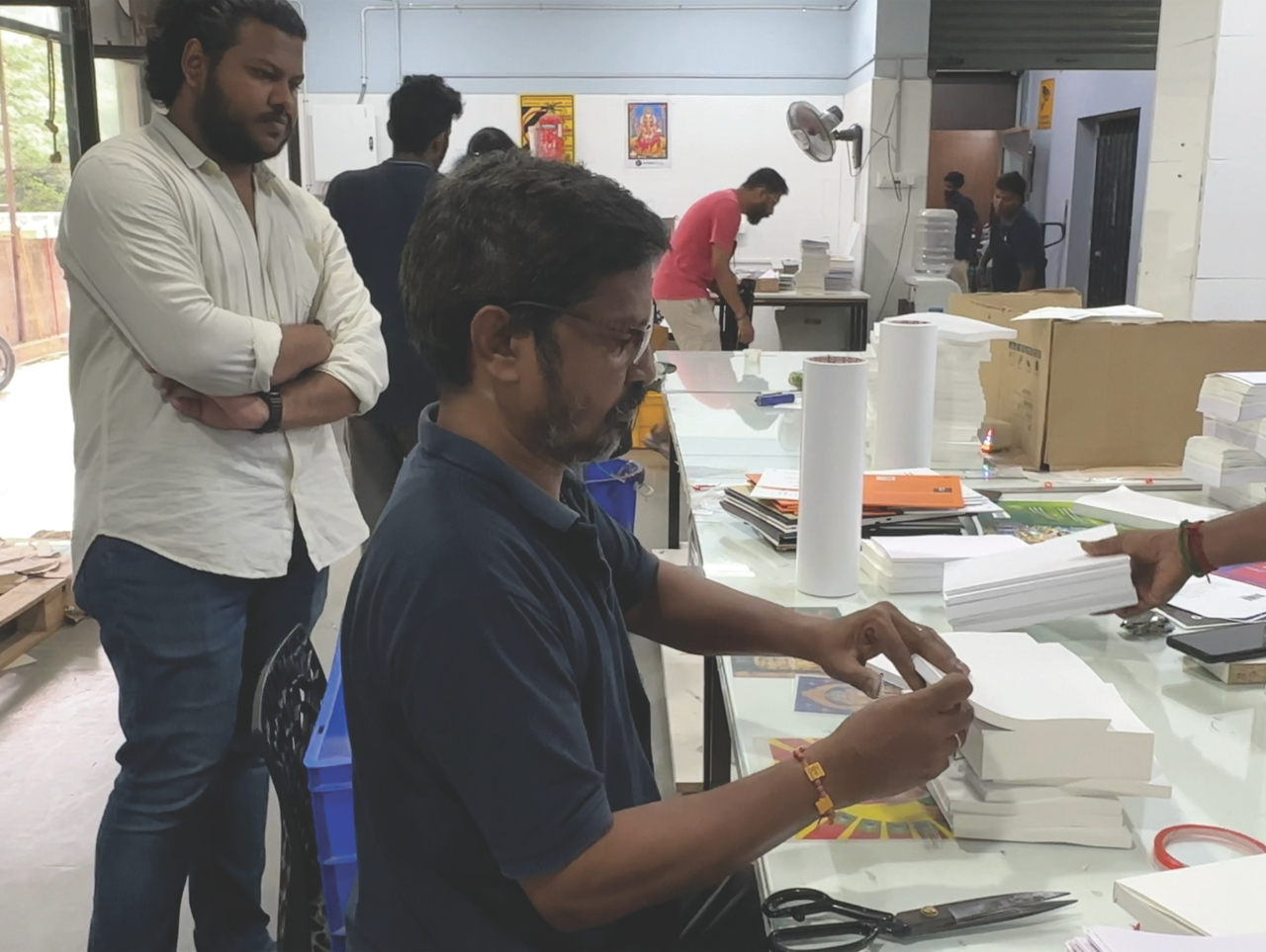
The press solely deals with digital printing, and each day, 20,000 to 25,000 books are collected from the Chennai and Noida factories, supported by Konica Minolta machines. Notion Press has standardised its papers, dealing with four to five types of papers. For instance, fiction and non-fiction books get printed on 70-80-gsm Seshasayee papers, while art paper is used for printing coffee table books. Valsakumar reflects, “Standardisation helps in maintaining high levels of efficiency.”
As for post-press services, Valsakumar comments, “Print-on-demand in India is yet to evolve to the stage where special effects are utilised effectively. We have realised that to produce books faster, the workflow must be kept simple, without complicating the publishing process.”
Literature for all
Valsakumar asserts, “Every voice and every story matters. Except when it is illegal, we do not reject any literature.” He adds firmly, “We follow strict quality control checks for legalities such as copyright infringements.” He shares, “I remember an author who wished to publish just one book. The author collated his memories and published the book to give to his wife. I recall printing simply one book for him, that is the magic of self-publishing.”
Valsakumar is seeing a shift in literature. He notes that non-fiction business books and poetry are taking over the publishing industry. He comments, “Poetry has always been overlooked in India, but a lot of young Gen Z poets are writing poetry. They are selling thousands of copies at book launches.”
Business biographies are in, according to him, he says, “Currently, we are working with at least 100 companies attempting to document their business in a book.” He beams, “No, it is not mainstream.” Taking a pause, he adds, “Yet. The magic of being in publishing and printing is that you get to know trends before they happen.”
Efficiency and automation
Artificial intelligence plays a major role at Notion Press, but Valsakumar notes, “We made a conscious decision not to let AI write.” The press deploys AI to enhance writing, he remarks, “We value human creativity and aim to empower human creators.”
With AI assistance, the press has published 1,20,000 titles. Notion Press deploys AI for various tasks, including data analytics, book tracking, design, marketing, and promotional strategies. Looking forward, Valsakumar aims to release an AI end-to-end workflow, which allows authors to enhance writings, design book covers, and help make decisions about metadata. The team is working to develop a personalised AI marketing bot which will provide tailor-made content for promoting each book title.
Moving forward
Notion Press’ community, consisting of about 15-lakh writers, is tech-powered. Valsakumar explains, “Notion Press is synonymous with technology. The only reason we can publish a new book every 30 minutes is because of how we empower our community to complete complex tasks by simplifying them using our technology.”
In addition, Notion Press brings community members together by organising workshops, author education programmes, and webinars. He says, “We invite top writers to teach aspiring authors how to improve their writing.”
Valsakumar smiles, “My favourite part of working with Notion Press is the team. My core team that I have worked with, from day one, are still with me.” He adds, “What I like about what we do is that work does not feel like work. Even though we have grown as a company, our work culture operates like a start-up — we care about each customer, because we only had five at that time.”

Moving forward, Notion Press is working toward building a book truck. Valsakumar chuckles, “It is an experiment driven out of madness. Our aim is to build a book truck in 100 days — the idea is to figure out a way to make bookstores viable again.”
Just like that, curiosity sparked an interest, and Naveen Valsakumar created an identity from an idea and revolutionised self-publishing for the years.
What is your favourite book?
Ayn Rand’s Atlas Shrugged.
Who are some of your favourite authors?
I love a lot of Indian authors — Manu Joseph is special. I like Seth Gordin as well.
If you could time-travel in a book as a fictional character, which book would you choose?
Gandalf from The Lord of the Rings.
What is your favourite genre?
Business biographies.
According to you, what genre is overlooked the most?
In India, poetry and sci-fi are widely underappreciated.
What are your favourite trends in the publishing industry at the moment?
I love that business houses are coming out and writing their stories.





 See All