

Where the story begins
When PrintWeek and WhatPackaging? launched the Women to Watch Awards in 2023, the brief was deliberately straightforward: find the women doing the actual work and put them on the record, no token representation.
Seventy entries came in across 48 participants for that first edition. By 2024, the count had crossed 50 entries across 13 categories, with participation the organisers described as a “significant surge.”
The 2025 edition, announced in September, extended the geography and scope further still. Three years in, the awards have quietly accumulated a documented record of who women in India’s print and packaging industry actually are, what they build, what they fix, and where they think the industry is going. This feature draws entirely from those records.
The picture that emerges is not one of a beleaguered minority waiting for permission. It is a sector where women are running production floors, managing sales cycles, developing patentable packaging materials, scaling factories, and, in several cases, building the very platforms through which the next generation will enter the industry.
What the numbers say
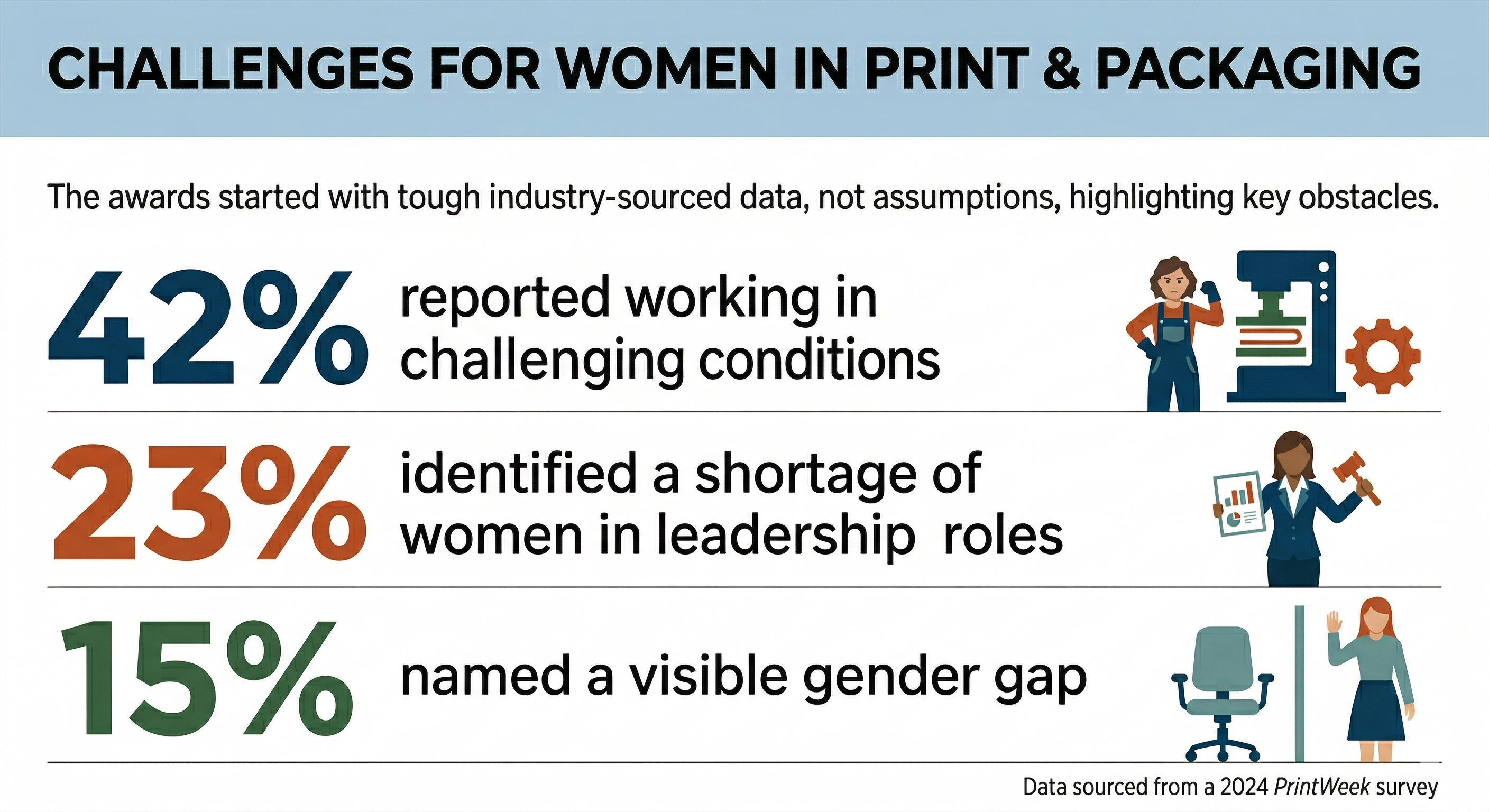
The awards did not begin with good news on the data side. In 2024, a PrintWeek survey found that 42% of women in the print and packaging industry reported working in challenging conditions, 23% identified a shortage of women in leadership roles, and 15% named a visible gender gap. These are industry sourced figures, not assumptions.
Siegwerk’s Ashish Pradhan, sponsor of the inaugural 2023 edition, cited studies showing that diverse teams make better decisions up to 87% of the time, and that diversity increases the likelihood of capturing new markets by 70%. He also noted plainly that “women are under-represented, especially in our industry,” and that Siegwerk had defined a concrete representation target for women in leadership. The gap is not just about senior titles.
KS Rajalakshmi at ITC, a 2023 winner, stated it without softening, “Nowadays, women require a seat at the table and not a separate table.” She added that the ratio of women in manufacturing remained low compared to software and hospitality, and that her company had committed to top down efforts on women’s recruitment, supported by physical infrastructure changes.
By 2025, the tone had shifted. Women in print and packaging are now shaping processes, driving innovation, and holding leadership positions across the board. The entries themselves back that claim. The factory floor If there is one space where the industry’s gender perception lags most, it is the factory floor. Yet over the past three years, Women to Watch winners have steadily dismantled the idea that manufacturing is not for women.
Srishti Kaushik of Nutech Print Services, named Factory Champion 2024, reframes the very nature of shopfloor work, “It’s no longer about manual labour but about innovation and technology. Your brain is the biggest muscle.”
She also observes that “women are not only limited to office work. They work in all departments, including folding, binding, quality checking and packing.” Structural changes across organisations — from safe transport to better facilities — are making participation possible.
Nalani Jaichandra of Veepee Graphic Solutions speaks to both the support she has found and the mindset required, “In a male-dominated industry, their trust and encouragement have been my driving force,” and, on the pace of change, “If we do not accept and embrace change, we risk becoming stagnant and irrelevant.”
Leadership from the inside
The leadership categories reveal a clear pattern: growth comes not just from ambition, but from systems, adaptability, and long-term thinking. Priyata Raghavan of Sai Packaging attributes success to disciplined execution, “Consistency, professionalism, focus on people and systems.”
Priya Singh of Hachette India reduces production philosophy to its essentials, “Maximise margin and minimal waste.” There is no single leadership style that emerges across the three editions. Raghavan leads through systems and compliance. Singh leads through meticulous process design.
Rituricha Jain of Paperdom leads hands-on, on the workshop floor. Nidhi Agrawal of DesignNBuy leads by adapting to her clients’ operational reality. The variation matters — it argues against the idea that women need to adopt a specific mode to succeed in manufacturing or publishing.
Women mentorship
The 2025 Mentor of the Year, Priyanka Rathi, defined the work plainly, “It is about producing leaders who will mentor others.” The 2024 winner, Arpita Das, said she wished more senior industry figures were interested in it, and highlighted what is lost when they are not, “Women and queer professionals bring nuance — they listen.” The 2023 winner, KS Rajalakshmi, demonstrated what mentorship looks like in practice through a junior employee named Dhanalakshmi, whose initiative she noticed and acted on.
What is slowly becoming clear across these three accounts is that informal mentorship is already happening. The gap is in formalising it and creating the structures that make it replicable. The emphasis is shifting from access to continuity — not just bringing people in, but ensuring they grow and stay.
Sales: The importance of discipline
Sales in print is not persuasion alone — it is technical understanding, adaptability, and clarity of value. Tania Hansoti captures the shift from corporate to manufacturing realities, “The most significant challenge was moving to a more fluid, hands-on environment.”
Rajalakshmi Ezhumalai distils her approach simply, “Listen more than you speak.” Across markets — metro and non metro, manual and automated — the message is consistent. Sales is a discipline built on insight, not instinct.
Sustainability and R&D
Every edition has featured sustainability prominently, but the character of the conversation has changed. In 2023, it appeared mainly as regulatory compliance and brand positioning.
By 2024, it was appearing in R&D awards for genuine material innovation. By 2025, it had become inseparable from technology, with winners like Tejaswini Patil working on materials that redefine what packaging can be, and sales professionals like Varsha Pal designing entire trade show themes around what she called “Future Is Eco-Tech.”
Jain of Paperdom quantifies impact, “For every tonne of paper we produce, we save an average of 17 trees.” Patil reframes product innovation itself, “Millet-based edible straws make sustainability noticeable and pleasurable.” The trajectory is not linear, but the direction is consistent.
Technology is the key
Technology is no longer an enabler — it is the driver of change. The 2025 editorial observed that “the world is at the cusp of an AI revolution and the printing industry is no stranger to this.”
The evidence in the awards is specific: Yashwi Jain automating pre-press workflows with a computer science background, Kaveri Satija achieving 90% proof-to-press accuracy with new CDI technology, Nidhi Agrawal building a web-to-print platform for 2,000 clients, Tania Hansoti implementing ERP systems that make every production stage transparent. Technology is not a separate theme — it is now embedded in every other category.
Multiple entry points
Next-generation women are building new verticals within the existing models, often in response to market shifts that older structures weren’t positioned to serve.
Shreya Mardia entered Unique Tags in 2017 and built a printed fabric labels division from scratch to 12-million pieces per day. Zeenia Khushru Patel led Jak Printers through the Covid months and built a packaging department alongside Print Yatras that brought outside visitors into the factory. Isha Deshpande joined Trigon Digipack during the pandemic and extended it from proofing into full commercial packaging runs.
Looking forward
PrintWeek’s 2026 Women to Watch Awards will be the fourth edition. What the first three years have produced, cumulatively, is a sourced record that is harder to dismiss than a single year initiative.
The record shows women running factories, developing patented materials, building global platforms, managing hundred-crore production budgets, designing packaging for global FMCG companies, and training the next generation of industry professionals. It also shows where the gaps remain.
The factory floor is still where acceptance is most unevenly distributed. Mentorship is still informal in most companies. The data on representation at leadership level is still unflattering. Infrastructure — safe travel, sanitation, shift accommodation — is still a prerequisite that gets listed as an achievement when it is provided.