


Bindwel roundtable stresses the importance of error-free books
From lamination cracks to signature mix-ups, India’s book value chain put its worst mistakes on the table at Bindwel’s annual roundtable. Treya Sinha reports on a session that reframed failure as the starting point for better craft.
22 Dec 2025 | By Treya Sinha

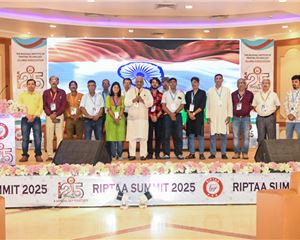
On 29 November, India’s leading publishers and book manufacturers gathered for the annual Printed Book Value Chain Roundtable, hosted by Bindwel
Nearly 50 of India’s leading publishers and book manufacturers gathered at the India Habitat Centre for the annual Printed Book Value Chain Roundtable, hosted by Bindwel on 29 November. This year’s theme, The Book of Mistakes – Learning from Failures, Celebrating Craft, spotlighted the failures rather than the successes.
The event opened with a curated display of fifty books—each representing a different production failure. Some were sourced from publishers, while others were recreated by Bindwel’s engineering team to illustrate issues ranging from lamination defects and cover cracking to wrong grain direction, blowholes, and signature mismatch.
“Rejection is the biggest hidden cost in book manufacturing,” noted Sajith Pallippuram of Bindwel. “One rejected book is not only wasted material, it often means a lost customer.” He emphasised that errors frequently originate much earlier than binding, in planning, substrate choice, environmental conditions, and curing processes.
Technical deep dives were led by Bindwel’s CTO, Suresh Nair, who demonstrated real samples of cracking, silvering, delamination, and crow’s feet. Nair explained how incorrect dyne levels, insufficient ink curing, or improper creasing can lead to failures that appear only during trimming or after exposure to heat and humidity.
Publishers highlighted operational challenges, particularly the pressure for faster turnarounds. “When a book is needed in 24 hours, curing time becomes a casualty,” one participant remarked. Grain direction and paper variability emerged as critical concerns—several attendees shared cases where even top-tier mills supplied paper with incorrect grain orientation.
A philosophical perspective came from Kai Buentemeyer, the director at Bindwel, who reminded the audience that industrial quality is about conformity, not ornamentation. He argued that consistency—starting with simple fundamentals such as accurate counts—forms the backbone of reproducible quality.
Discussions concluded with industry-wide agreement that zero-rejection processes require transparency, collaboration, and adherence to workflow discipline. Bindwel presented its BindRight program, which offers audits, training, and machine calibration support at no cost.
Participants described the session as one of the most candid and practical industry roundtables to date, bringing publishers and printers together around a shared mandate: to learn from failures and strengthen the craft of bookmaking.
The importance of being fundamental
The gathering of book industry leaders on 29 November concluded with a stark realisation that as the Indian market matures, a zero-tolerance approach to quality defects is no longer optional. The discussion, titled to address the “errors and horrors” in book manufacturing, emphasised that despite significant economic growth—cited as 8.2% GDP growth—the failure to correct production flaws could jeopardise the Indian book industry’s standing.
The discussion highlighted that quality rejections are the single biggest cost in book printing, as they result not only in the loss of a book but often the loss of a customer. An exhibition of “50 odd books, each one having a different problem,” served as a tangible reference point for common production flaws.
Some of the common errors that were discussed during the roundtable exchange were lamination failures. This included issues like delamination (the film peeling off the cover) and silvering (shiny lines at the crease) which are frequent occurrences, particularly with digital printing. The consensus during the roundtable discussion was that many lamination problems stem from neglecting the necessary curing time of 48 to 72 hours for inks to dry before lamination.
Later, the publishers, printers, and equipment suppliers spoke about cover and binding issues. This included defects like “first page, last page opening” problems. This is often caused by incorrect paper grain direction or inadequate creasing. Problems were also noted when the book cover was shorter than the book block or when thin books were given overly thick covers to mimic a hardcover.
Also spotlighted were process and assembly errors, which included: wrong signatures (missing, upside-down, or duplicate printed sections/forms); blowholes: gaps that appear in the spine or near the head of the book, often due to improper bundling or a lack of perforation in the paper; and miscollation: incorrect sequencing of pages or forms within the book.
Beyond technical fixes, a significant part of the dialogue focused on cultural and operational shifts required across the value chain, from publisher to printer. Some of the hotly debated topics were quality checks at every stage. Many participants stressed that quality assurance must be integrated into the organisation’s “DNA,” moving away from a final inspection model. As one speaker noted, “If you put a quality check at the end, all problems are going to happen.”
Another key theme was Root Cause Analysis (RCA). Publishers were urged to demand a Root Cause Analysis (RCA), also known as Collective Action, Preventive Action (CAPA), for every rejection. This forces printers to acknowledge, investigate, and correct the fundamental reasons for failure, sensitising every level of the production team.
The chronic issue of inconsistent paper quality from mills was raised, with printers lamenting the lack of a “paper passport” or Certificate of Analysis. The industry was advised to work only with suppliers who can provide quality certifications. Also a call was made to improve basic operational efficiency. Errors in counting and inventory control lead to a significant waste of material and factory space.





 See All